
Styrene Acrylic Surface Sizing Agent: A Complete Guide for Papermakers
Styrene Acrylic Surface Sizing Agent: A Complete Guide for Papermakers
A styrene acrylic surface sizing agent (SAE) is a synthetic polymer emulsion applied to paper at the size press to control water absorption, improve surface strength, and enhance printability. It helps papermakers produce grades that resist moisture without sacrificing the surface quality needed for high-speed printing and converting. This guide explains how SAE surface sizing agents work, how they compare with other sizing chemistries, and what to consider when selecting one.
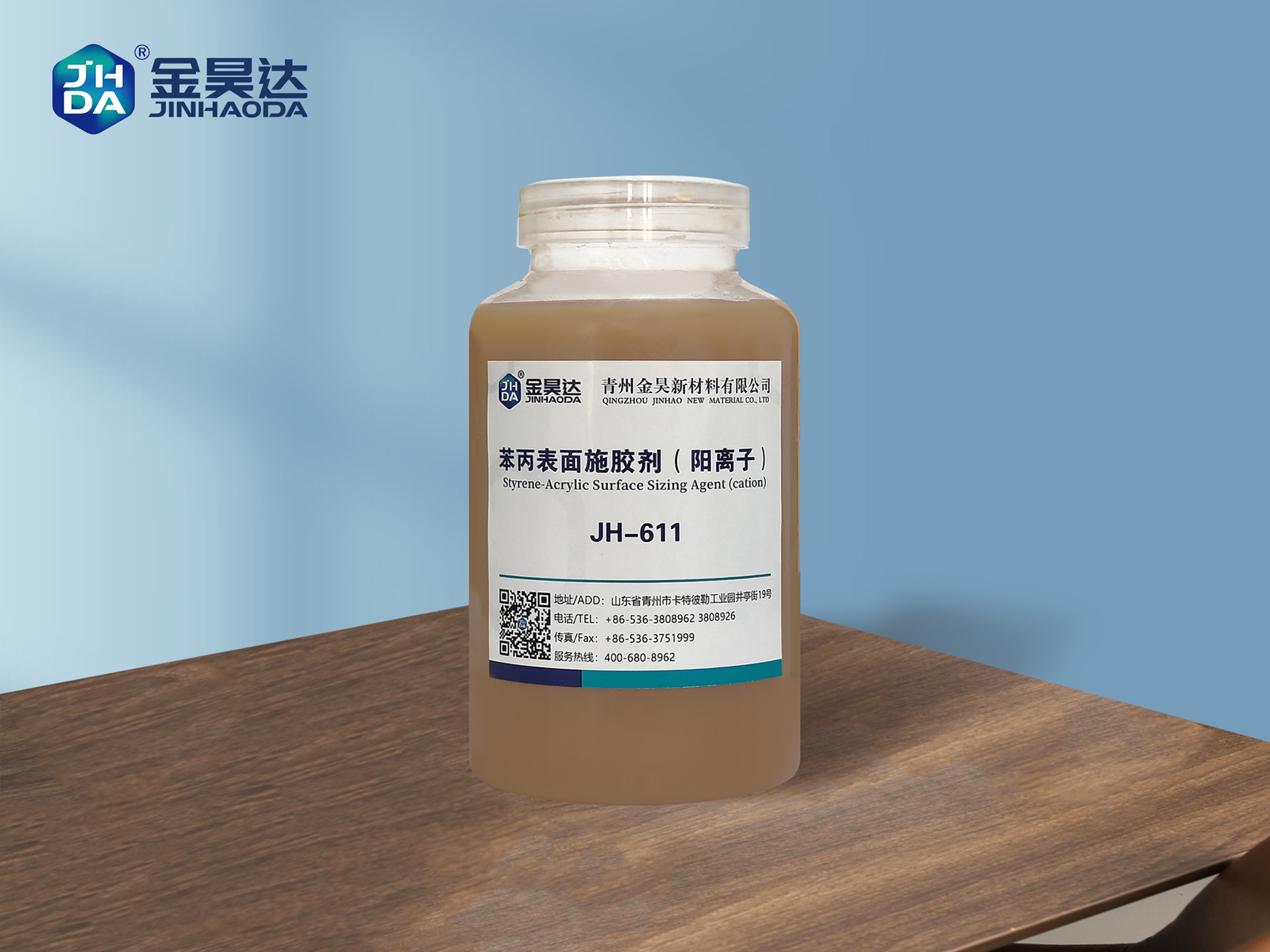
JHDA styrene acrylic surface sizing agent (model JH-611)
Why Paper Needs Sizing Agents
Paper is made from cellulose fibers that naturally absorb water and moisture. Without protection, paper products quickly lose strength, show water stains, and fail printing tests. A sizing agent changes the surface or internal pore structure of paper so that water and aqueous liquids do not penetrate easily.
There are two main ways to add sizing chemistry:
- Internal sizing adds the agent directly to the pulp slurry before sheet formation. It reacts with fibers throughout the sheet thickness and is often used for packaging grades that require bulk water resistance.
- Surface sizing applies the agent onto the already-formed, dried paper web at a size press. This is an efficient method because the chemicals stay on the surface, where water repellency and printability matter most.
Surface sizing is especially important for printing and writing papers, as well as for corrugated packaging, because it provides a clean, strong, and water-resistant surface without requiring excessive chemistry at the wet end.
The Industry at a Glance
The global paper sizing agent market was valued at approximately USD 3.8 billion in 2025, according to Dataintelo. The same source projects the market will reach USD 5.9 billion by 2033, growing at a CAGR of 5.8%. Asia Pacific leads the market with a 42.3% revenue share in 2025, reflecting the region’s strong paper production activity. Global consumption of sizing agents exceeded 3.8 million metric tons in 2024, as reported by Market Reports World.
From a chemistry perspective, synthetic sizing agents including AKD and ASA held a 54.5% market share in 2024, while rosin sizing accounted for 32.4% of revenue in 2025. Liquid sizing agents dominated the market with a 57.8% share in 2024 because they are easy to pump and dose on automated paper machines. Among synthetic products, AKD sizing represents about 48% of synthetic sizing volume globally. Although AKD is widely used for internal sizing, styrene acrylic (SAE) surface sizing agents are increasingly preferred for improving printability and surface strength without the slow-curing issues of some internal sizing products.
Market data cited above is drawn from third-party reports: Dataintelo, Market Reports World, SNS Insider, and Mordor Intelligence. Estimates may vary by source and methodology.
Problem Definition: Challenges That Sizing Agents Solve
Papermakers run into several common problems that a sizing agent can solve:
Excessive Water Absorption (High Cobb Value)
Packaging papers, especially corrugated board and linerboard, must resist water in humid conditions or during transport. If the Cobb value is too high, the paper softens, loses ring crush strength, and can collapse under stack loads. A surface sizing agent with water-repellent properties reduces water pickup and keeps physical strength intact.
Poor Surface Strength and Linting
During high-speed offset printing, loose surface fibers can cause “linting” or “picking,” which marks the printed surface. SAE surface sizing agents form a tough, cross-linked film that binds surface fibers and improves surface bonding strength.
Ink Feathering and Bleeding
Writing and printing papers need a surface that holds ink without spreading. A properly formulated surface sizing agent both controls water uptake and provides a barrier that prevents ink feathering, giving sharper text and images.
Slow Curing of Traditional AKD
AKD internal sizing agents often require time after drying to develop full water resistance. This curing delay occupies warehouse space and slows finished goods turnover. Surface-applied SAE sizing agents, in contrast, reach their final sizing effect once the paper passes through the drying cylinders, providing immediate results that allow direct rolling and shipping.
Detailed Solution: Styrene Acrylic Surface Sizing Agent
A styrene acrylic surface sizing agent is an aqueous emulsion of styrene and acrylic copolymers. When applied to paper with starch, the polymer particles coalesce and cross-link on the fiber surface, forming a hydrophobic film. This film controls water penetration, strengthens the surface, and improves print quality.
SAE agents can be formulated as anionic, cationic, or composite systems. The ionic character affects how well the agent bonds with starch and cellulose. Cationic SAE products often deliver more uniform coverage with anionic starch, while anionic SAE products are widely used in cultural paper production due to cost efficiency.
Qingzhou Jinhao New Material Co., Ltd. (branded as JHDA), founded in 2005 and headquartered in Qingzhou City, Shandong Province, China, is a manufacturer of papermaking fine chemicals. Its product portfolio includes AKD sizing emulsion, cationic styrene-acrylic surface sizing agent, paper dry strength agent, PAE wet strength resin, and other process chemicals. The company’s surface sizing products include the following models:
JH-611 – Cationic SAE Surface Sizing Agent
JH-611 is a brown liquid made of styrene acrylic copolymer. It has a solid content of 30.0 ± 1.0%, pH of 2.0–5.0, viscosity ≤50 cps at 25°C, and a shelf life of six months. It is designed for corrugated paper and boxboard, and is compatible with ordinary raw starch. Because it is cationic, it can work directly with anionic starch systems and can replace wet-end internal sizing agents without a curing period. The product improves ring crush stiffness, surface hardness, and smoothness, while reducing sizing chemical procurement costs.
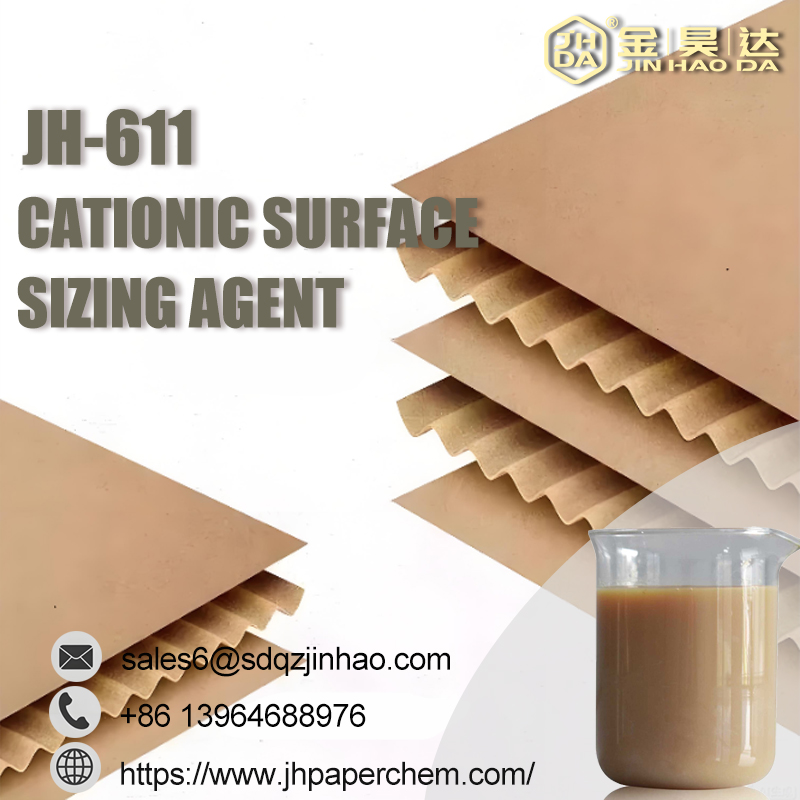
JH-611 styrene acrylic surface sizing agent in a surface sizing scenario
JH-325 – Anionic SAE for Cultural Paper
JH-325 is an anionic styrene acrylic surface sizing agent specifically classified for cultural paper (printing and writing paper). It is a white-to-light-brown liquid with 25.0 ± 1.0% solid content, pH 2.0–5.0, viscosity ≤50 cps, and a six-month shelf life. The anionic copolymer cross-links rapidly with starch, improving dry and wet surface strength, reducing linting, and optimizing ink affinity. It works in both acidic alum-based systems and modern neutral papermaking systems.
JH-600 – Moisture-Resistant SAE Surface Sizing Agent
JH-600 is a moisture-resistant SAE surface sizing agent designed for packaging paper that faces humid storage or maritime transport. It appears as a light-brown-to-dark-brown liquid, contains 30 ± 1% solids, has a pH of 2.0–5.0, and a viscosity below 50 cps at 25°C. Its cationic molecular structure helps it form a dense protective film that blocks moisture infiltration and prevents strength decay in high-humidity environments. The product is particularly useful for rainy-season production and cold-chain packaging applications.
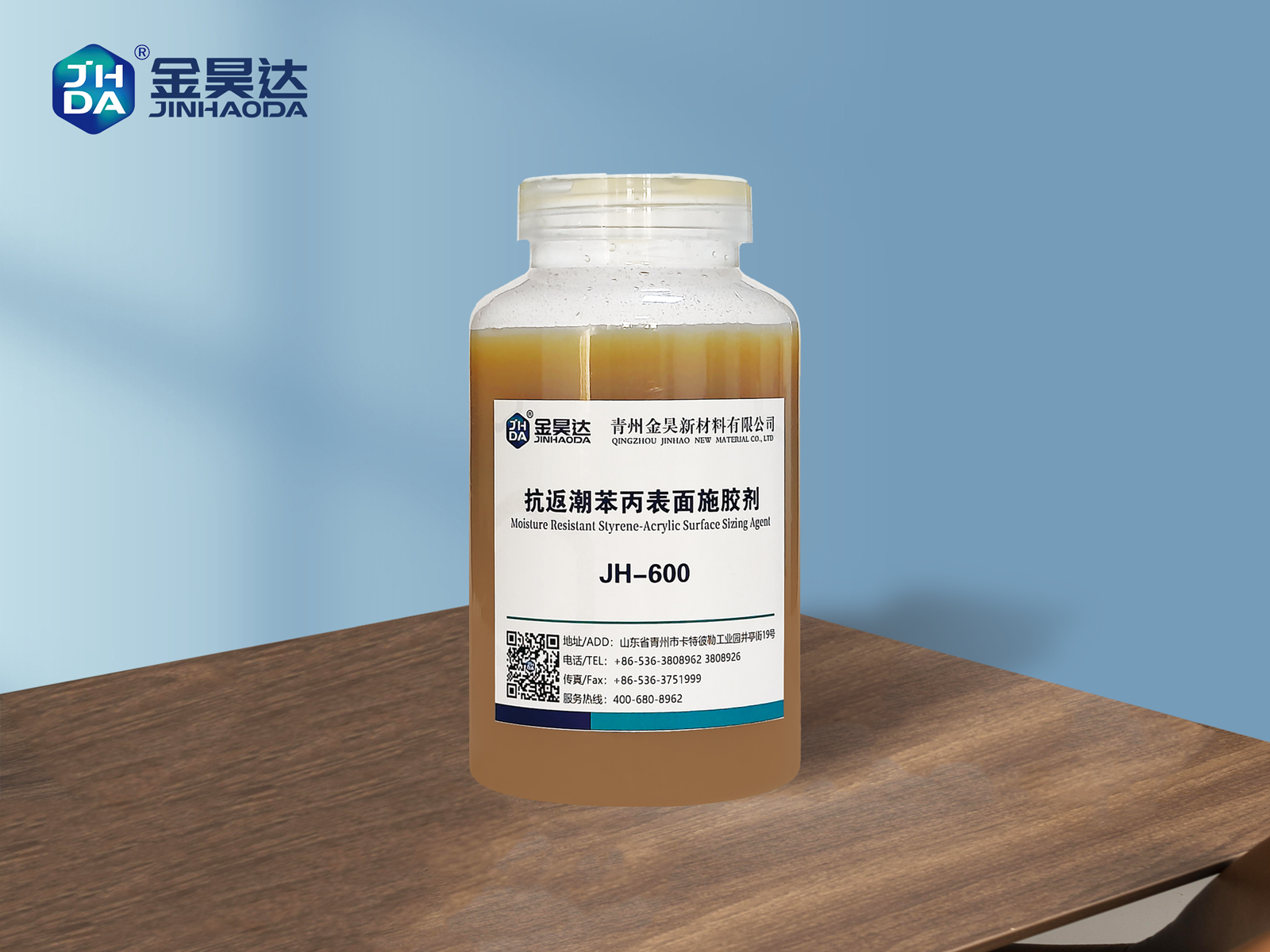
JH-600 moisture-resistant SAE: designed for long-term resistance to moisture absorption
JH-WH3364 – Composite SAE+AKD Surface Sizing Agent
JH-WH3364 is a composite surface sizing agent made from weak anionic styrene acrylic and AKD. It combines AKD’s reactive water resistance with SAE’s film-forming toughness. This hybrid product is supplied as a milky-white-to-pale-yellow liquid with 25.0 ± 1.0% solids, pH 2.0–5.0, and a shelf life of four months. It can replace the separate dosing of AKD emulsion and SAE sizing agent, simplifying the production process while delivering dual benefits: immediate sizing after drying and improved surface strength.
The Role of AKD in Surface Sizing
For context, JHDA also manufactures AKD-based sizing agents. JH-103 is an AKD emulsion internal sizing agent used to waterproof pulp. JH-200 is a surface-applied AKD sizing agent that is compatible with starch and reaches final sizing after the dryer. These products are not SAE, but they illustrate the range of choices available to papermakers. In many cases, a composite product such as JH-WH3364 can provide the easiest path to balanced performance.
How to Use a Styrene Acrylic Surface Sizing Agent: Step-by-Step
Surface sizing with an SAE agent can be adapted to most paper machines. The following workflow reflects common practice and the product features of JHDA’s SAE grades:
Step 1: Define Your Target Water Resistance and Surface Strength
Determine the Cobb value, ring crush, and print test requirements of your final paper grade. This will guide the choice between a cationic SAE (e.g., JH-611), an anionic SAE (e.g., JH-325), or a moisture-resistant/composite grade (e.g., JH-600 or JH-WH3364).
Step 2: Prepare a Starch / SAE Mixture
Most mills use oxidized or ordinary industrial starch as the carrier. The SAE agent is blended into the starch solution with simple stirring. JHDA products are compatible with common industrial starches and require no pre-dissolving preparation, according to the product data. Cationic SAE grades will bond uniformly with anionic starch, while anionic grades such as JH-325 cross-link rapidly with starch components.
Step 3: Dose at the Size Press
The mixed sizing liquid is applied at the size press. JHDA liquid products can be fed using an automatic metering pump. Their low-foaming properties and shear resistance allow stable operation on high-speed sizing machines without bubble pinholes or streaks.
Step 4: Dry and Cure
After the paper passes through the drying cylinders, the SAE film is set. Unlike traditional AKD internal sizing that may require hours or days of curing, SAE surface sizing delivers a stable water resistance immediately after drying. This allows direct rolling and expedited delivery.
Step 5: Verify Paper Performance
Check key indicators using standard methods: Cobb water absorption for water resistance, ring crush for packaging strength, and print tests for dusting or ink bleed. JHDA’s field technical team offers on-machine debugging services, and the company’s pre-shipment laboratory testing supports formula adjustment before bulk production.
Use Cases: Where SAE Surface Sizing Agents Deliver Value
Printing and Writing Paper
Cultural paper grades require a smooth, well-bonded surface for offset and digital printing. An anionic SAE such as JH-325 is a cost-efficient choice because it works with low-cost industrial starch, reduces the amount of high-priced sizing agent, and improves print clarity by controlling ink penetration.
Corrugated Paper and Boxboard
Corrugated medium, test liner, and boxboard are commonly produced from recycled pulp, which tends to have high water absorbency and low surface strength. Cationic SAE grades such as JH-611 provide ring crush improvement and water resistance, and they can partly replace wet-end internal sizing. This reduces chemical loss in the white water system and lowers overall sizing costs.
Humid and Rainy-Season Packaging
Packaging paper sold in tropical or rainy climates faces moisture reversion during storage. JH-600 was developed for this scenario: it forms a dense hydrophobic film that slows moisture absorption and keeps physical indicators stable during long-distance maritime shipping or cold-chain logistics.
Mills Seeking Simplified Chemical Management
Instead of managing both AKD emulsion and SAE sizing agent as separate products, a mill can use a composite surface sizing agent such as JH-WH3364. This single product delivers waterproofing and surface strengthening, reduces dosing complexity, and cuts procurement overhead.
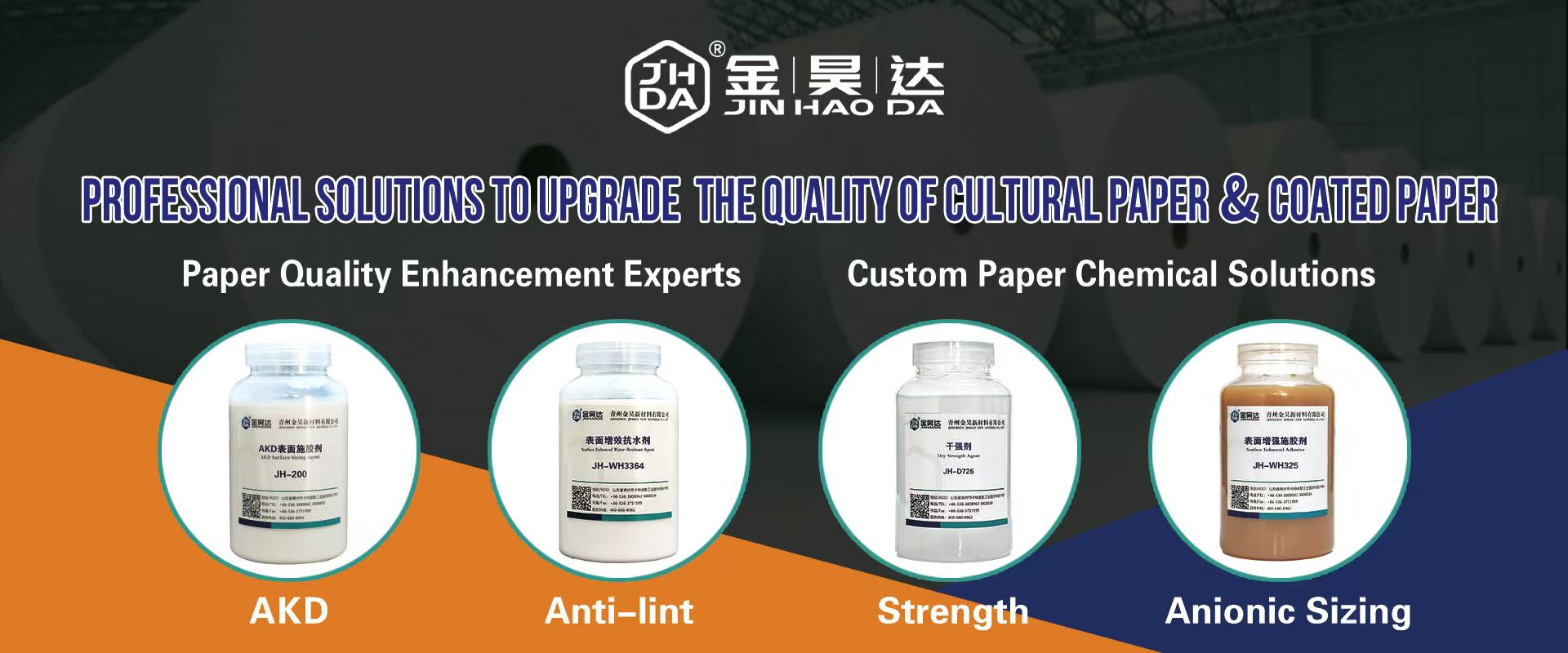
JHDA chemical solution for cultural paper production
Comparison Table: JHDA Sizing Agent Portfolio at a Glance
| Product | Chemistry | Ionic Type | Solid Content | pH | Best Suited For |
|---|---|---|---|---|---|
| JH-611 | Styrene acrylic copolymer | Cationic | 30.0 ± 1.0% | 2.0–5.0 | Corrugated paper, boxboard, packaging grades |
| JH-325 | Anionic styrene acrylic copolymer | Anionic | 25.0 ± 1.0% | 2.0–5.0 | Printing and writing paper |
| JH-600 | Styrene acrylic (moisture-resistant) | Cationic | 30 ± 1% | 2.0–5.0 | Moisture-proof packaging, rainy-season stocks |
| JH-WH3364 | SAE + AKD composite | Weak cationic | 25.0 ± 1.0% | 2.0–5.0 | Dual-function sizing with water resistance and surface strength |
| JH-103 | AKD emulsion (internal) | Cationic | 12.5–25.0 ± 1.0% | 2.0–5.0 | Wet-end internal sizing for neutral/alkaline systems |
| JH-200 | AKD surface emulsion | Cationic | 20.0/30.0 ± 1.0% | 2.0–5.0 | Surface sizing with starch for fast water resistance |
This table is based on JHDA product specification sheets. Mill-specific suitability should be confirmed through lab testing and on-machine trials.
Sizing Agent Selection: Key Decision Factors
When selecting a surface sizing agent, consider the following:
Ionic Compatibility
Cationic SAE grades are often preferred for starch sizes because they bind well with anionic starch and cellulose. Anionic grades are also effective and can be more economical, especially for cultural paper where the system is often neutral or slightly acidic.
Raw Material and Recycled Pulp
Recycled pulp contains impurities that can interfere with internal sizing. Surface sizing places the chemistry on the paper surface where it is less affected by pulp contaminants. This is one reason SAE surface sizing is popular for waste-paper-based packaging grades.
Machine Speed and Shear
High-speed sizing machines require low-foaming products with high mechanical shear stability. JHDA specifies its SAE products with viscosity ≤50 cps and notes their shear resistance for high-speed continuous operation.
Compliance and Certifications
For food-contact paper and export packaging, chemical compliance matters. JHDA holds ISO9001 and ISO14001 certification, and part of its product range meets food-grade standards. In addition, the company can supply SGS product compliance test reports and complete TDS/MSDS documentation for export clearance.
Frequently Asked Questions
1. What quality certifications does JHDA hold for its papermaking chemicals?
JHDA holds ISO9001 quality management system certification and ISO14001 environmental management system certification. The company also has HALAL certification and states that part of its products meet food-grade standards. For export customers, SGS product compliance test reports and complete TDS/MSDS documents are available to support customs clearance and L/C settlement.
2. Can JHDA SAE surface sizing agents replace imported brands such as Kemira Fennosize SC-29?
According to JHDA’s technical evaluation, replacing Kemira Fennosize SC-29 with a JHDA styrene-acrylic surface sizing agent is feasible for most packaging paper mills. JHDA says its products achieve equivalent Cobb values and water curing effects while lowering procurement cost and shortening delivery time. In practice, the paper machine, pulp composition, and final paper specifications must be reviewed first. For ultra-high-grade virgin pulp specialty paper with fixed certified formulas, keeping the original imported product is safer.
3. Is it more cost-effective to buy directly from JHDA than from a trading company?
Buying directly from JHDA as a manufacturer generally provides more direct quality control, customized formulation development, and prompt after-sales technical service. The company also supports factory audit visits for chemical distributors and terminal paper manufacturers. This can lead to lower total cost of ownership because technical issues are resolved directly by the R&D and field service team.
4. Can I request a sample before placing a bulk order?
Yes. JHDA invites papermakers and distributors to contact its international sales team directly for sample trials. The company also offers pre-shipment laboratory testing and customized chemical formulation development so that the product can be evaluated against your pulp type and machine conditions before a full-volume order.
5. How does JHDA ensure delivery for overseas customers?
JHDA has an established export process supported by one-stop documentation including commercial invoice, packing list, certificate of origin, pre-shipment inspection report, MSDS, TDS, and dangerous goods transport certification when needed. For ASEAN clients, the company has set up an overseas production entity, CRM Chemical Technology Co., Ltd., in Long An Province, Vietnam, which shortens delivery cycles for local customers.
Conclusion
Styrene acrylic surface sizing agents are a practical and high-performance way to achieve water resistance, surface strength, and printability in one size-press application. They are especially useful for papermakers using recycled pulp, producing packaging grades, or looking to simplify chemical inventory by replacing separate AKD and SAE dosing with a single composite product.
When selecting a product, focus on ionic compatibility, machine shear stability, curing speed, and compliance requirements. JHDA offers a family of SAE and composite sizing agents covering cationic, anionic, moisture-resistant, and SAE+AKD formulations. A direct conversation with their technical team can help turn your specific Cobb, ring crush, or print quality target into a workable sizing solution.
Download the JHDA company brochure to review the full papermaking chemical range: JHDA Introduction 2026 (PDF).
To discuss your paper grade, request samples, or get a bulk export quotation, contact the international sales team at info@sdqzjinhao.com or WhatsApp +86 139 6468 8976.
Have Questions or Need More Details?
Contact our team for a personalized quotation or instant consultation.
Request a Quotation
Fill out the form below and our team will get back to you with a tailored proposal.
WhatsApp Direct Chat
Prefer to chat in real-time? Message us on WhatsApp for instant assistance & quick answers.
- Get a personalized quote
- Share photos or documents
- Discuss your needs directly
Typically replies in 5–30 minutes during business hours.