
Paper Strength Agent Application Guide: Recycled Pulp Food-Grade Tableware Molding
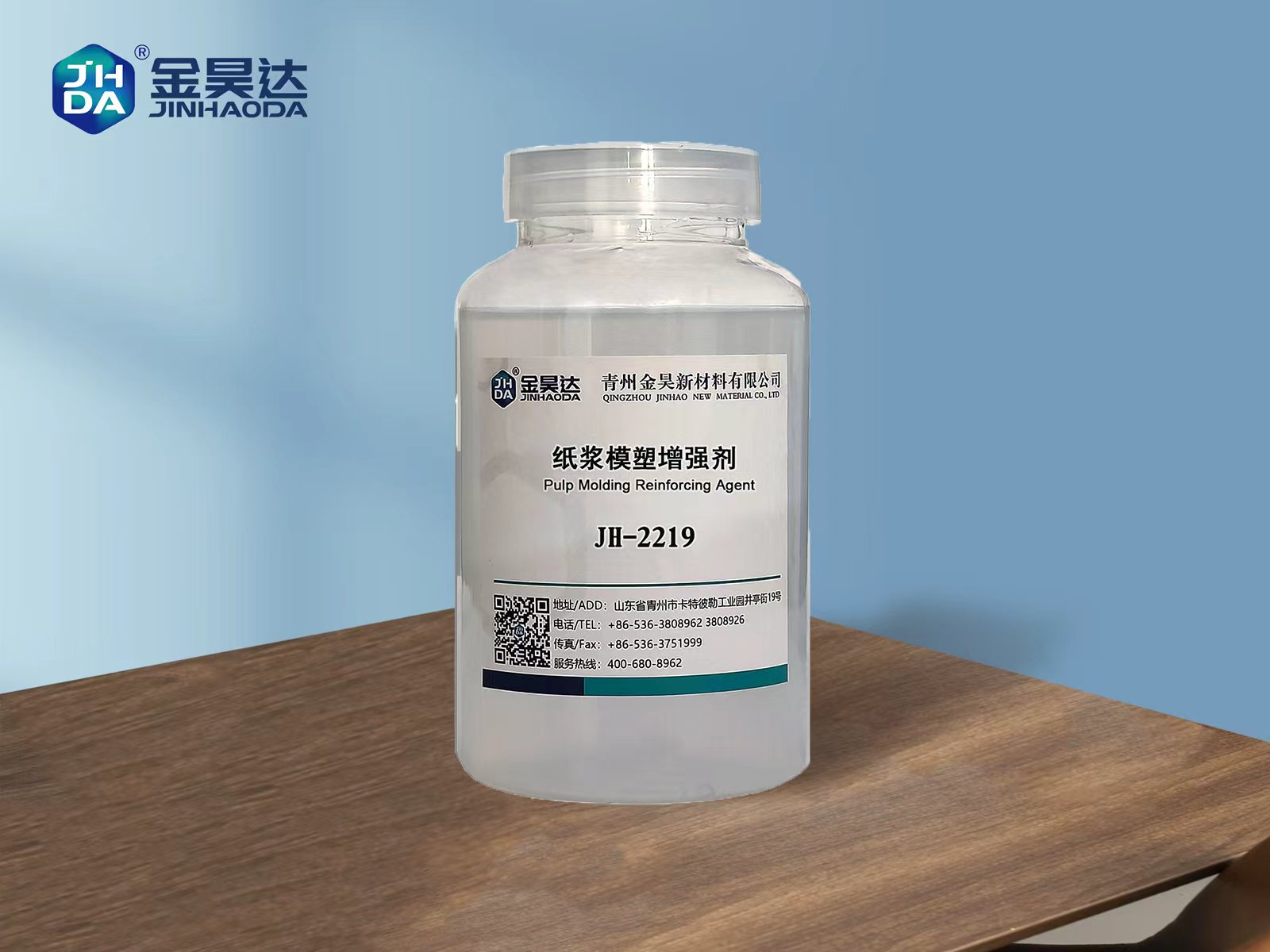
Direct answer: Adapting a paper strength agent to a recycled-pulp food-grade tableware molding line means rebuilding fiber bonding in the pulp slurry before the furnish reaches the forming die, while keeping the chemistry compatible with food-contact expectations. In the JHDA range that work is handled by two products. JH-2219 Pulp Molding Strength Enhancer is an amphoteric, water-soluble liquid with 20.0 ± 1.0% solids, pH 2.0–5.0, viscosity of 5000–12000 cps at 25°C and a 6-month shelf life, intended for pulp molding and paper manufacturing. JH-1697 Solid Dry Strength Agent is a cationic white powder with ≥95.0% active ingredient and a 12-month shelf life, used in papermaking and pulp molding where a solid format suits storage and dosing. Both are documented as formaldehyde-free and both list food-grade pulp tableware among their target applications.
This guide is written for mill and molding-plant teams at the research stage: buyers, process engineers and product developers who have decided that recycled fiber is staying in the recipe and now need to understand which strength chemistry to trial, where to add it, and which wet-end checks decide whether the trial succeeds or fails.
Problem Definition: Where Recycled Pulp Tableware Actually Loses Strength
Recycled fiber is not weak in one single place. It is weak all along the process. Waste-paper pulp carries shorter fibers and a higher fines load than virgin fiber, so the bonding surface available between fibers is reduced. In molded pulp tableware that shows up as a chain of defects rather than one number on a test report.
- Brittleness in the finished piece. Plates, bowls and clamshells molded from recycled pulp can become brittle and break easily. JH-2219 product data describes this specific failure mode — brittle and easy-to-break molded pulp goods — as a primary target for correction, and lists egg trays, fruit pulp trays and industrial buffer packaging molds alongside tableware.
- Movement during hot pressing and drying. Dimensional stability is where molding differs from papermaking. JH-2219 product data lists reduced deformation, warping and cracking during hot pressing and drying as an intended outcome.
- Breakage after the mold. Losses continue at cutting, trimming and packaging transport. Both JH-2219 and JH-1697 are documented as improving the machining performance of finished pulp mold and reducing breakage in those steps.
- Dependence on long virgin fiber. The traditional remedy is to raise the long-fiber share. Both products are documented as a route to lower the usage proportion of long virgin fiber for pulp molding production, which is where the raw-material cost sits.
- A compliance ceiling on the fix. A strength additive used on tableware cannot trade strength for compliance. JH-2219 is described as an eco-friendly water-based formula with no formaldehyde, non-toxic and odorless, fit for food-grade pulp tableware and food packaging pulp molds. JH-1697 is described as containing no formaldehyde and no harmful volatile substances, applicable to food-grade pulp tableware, food packaging paper and green packaging cardboard.
Two further constraints sit on top of the strength question. Wet-end chemistry in a molding plant is crowded — sizing agents, defoamers, retention aids and starch all circulate in the same white water — so any added strength agent must not flocculate the system or block the pulp circulation loop. And because recycled pulp quality fluctuates, the strength response has to be stable across changing pulp conductivity and pH, not only on the day of the trial.
Industry Background: Why Strength Chemistry Sits Higher on the Buying Agenda
The commercial context explains why so many molding plants are reviewing their strength program at the same time. Strength additives are an established chemical category, and recycled fiber is taking a larger share of the furnish that feeds them.
- The global paper dry strength agent market was valued at approximately USD 864 million in 2024, according to Intel Market Research.
- Asia-Pacific accounts for approximately 40% of the global paper dry strength agent market share (Intel Market Research, 2024), which is also where a large part of molded pulp tableware capacity is concentrated.
- The packaging and containerboard segment leads paper grade usage for dry strength additives with a 38.0% share (Fact.MR, 2026), confirming packaging as the volume driver behind strength chemistry development.
- Polyacrylamide (PAM) resins dominate the dry strength resin market with an estimated 40.0% share (Fact.MR, 2026). Both JH-2219 and JH-1697 are built on polyacrylamide-type chemistry in their respective formulations.
- Recycled paper share of all fiber used at U.S. mills increased to 44.4% in 2024, according to the American Forest & Paper Association — a direct indicator of the direction fiber supply is moving.
The practical reading for a tableware molder is straightforward. More recycled fiber in the furnish means more demand on the strength agent, and food-grade tableware adds a compliance filter that narrows the field of usable products. A strength agent that performs in linerboard but is not positioned for food-contact pulp tableware is not a candidate, regardless of its technical merit elsewhere.
The Detailed Solution: Two Paper Strength Agents for a Recycled Pulp Tableware Line
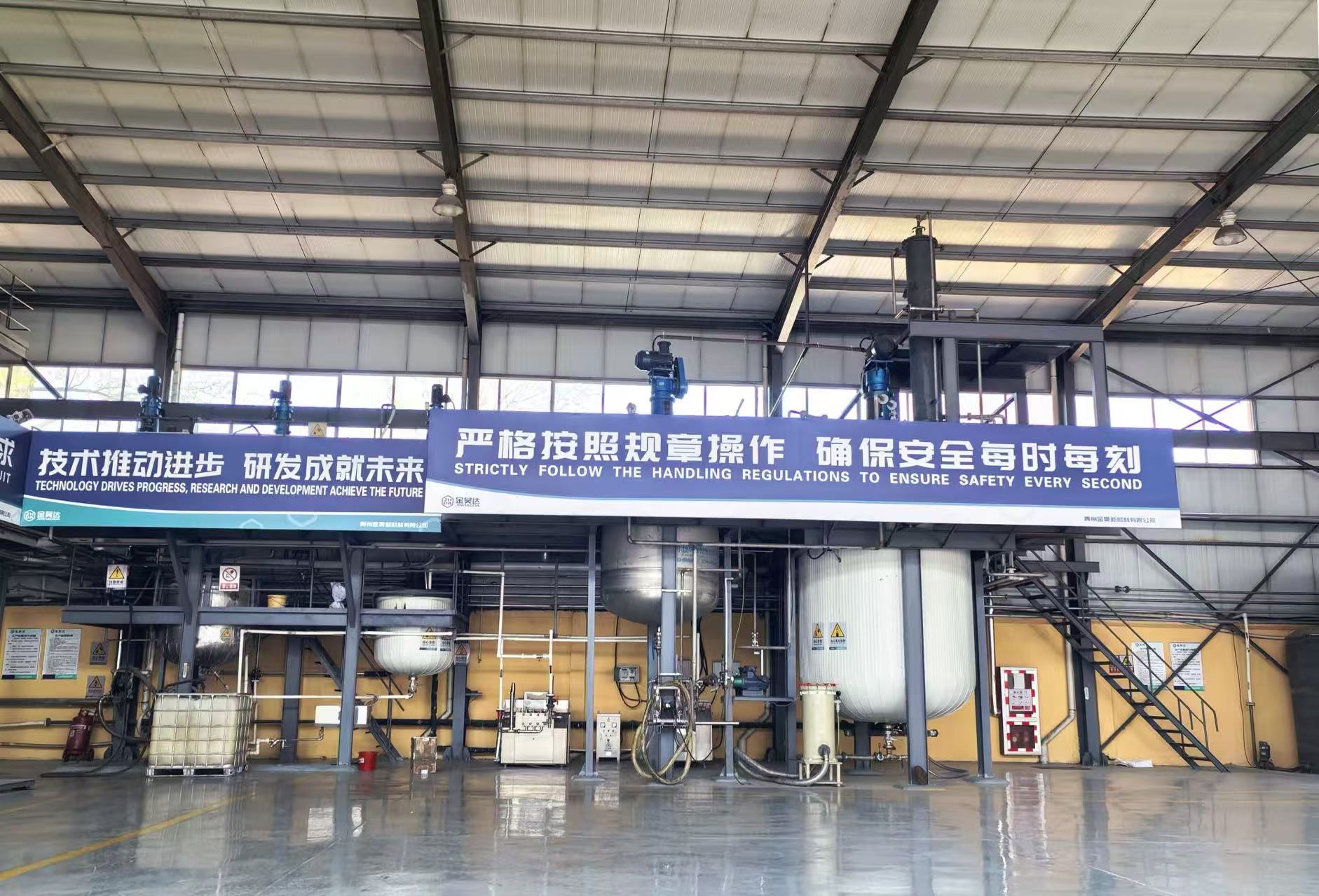
Qingzhou Jinhao New Material Co., Ltd., branded as JHDA, is a papermaking fine chemicals manufacturer founded in 2005 and located in Mihe Industrial Park, Qingzhou City, Shandong Province, China. The company states an annual output of 100,000 tons and a product portfolio that spans strength agents, sizing agents, retention and filtration aids, defoamers, biocides and coatings for food packaging paper. Its strength line is the relevant part of that portfolio here.
JH-2219 Pulp Molding Strength Enhancer (Liquid, Amphoteric)
JH-2219 is the primary recommendation for a recycled-pulp tableware molding line because its stated application set matches the process: pulp molding, recycled pulp, food-grade pulp tableware and food packaging pulp molds. It is classified as a pulp molding dry strength agent, a molded pulp reinforcement additive and a disposable pulp tableware strength agent.
| Parameter | JH-2219 Pulp Molding Strength Enhancer |
|---|---|
| Appearance | Light white to transparent liquid |
| Solid content | 20.0 ± 1.0% |
| pH | 2.0–5.0 |
| Viscosity (25°C) | 5000–12000 cps |
| Ionic type | Amphoteric |
| Solubility | Soluble |
| Shelf life | 6 months |
| Composition | Polyacrylamide, polyamine, polyamide epichlorohydrin resin, starch derivatives, cationic polyacrylamide copolymer, acrylic acid copolymer, water-based cationic resin |
| Intended industries | Pulp molding, paper manufacturing |
Functionally, JH-2219 is designed to adsorb rapidly onto the pulp fiber surface and form a stable ionic bonding network, which is the mechanism behind the stiffness, tensile toughness and compression resistance gains listed for molded pulp products. Three handling characteristics matter on a molding line. First, it is a water-based liquid that dilutes in cold water and mixes uniformly with pulp slurry, with no heating step before dosing. Second, it is documented as compatible with other wet-end additives such as sizing agents and antifoaming agents, without flocculation or system blockage in the pulp circulation system. Third, it is described as leaving less sticky residue on the molding mold surface, which reduces mold cleaning frequency and supports forming-mold service life.
JH-1697 Solid Dry Strength Agent (Powder, Cationic)
JH-1697 is the solid alternative, and it is positioned for both papermaking and pulp molding. It is the better fit when powder handling, warehouse space or freight cost dominate the decision, and it is also the product to evaluate when pulp quality and water hardness swing widely.
| Parameter | JH-1697 Solid Dry Strength Agent |
|---|---|
| Appearance | White powder |
| Active ingredient | ≥95.0% |
| Ionic type | Cationic |
| Solubility | Soluble |
| Shelf life | 12 months |
| Composition | Cationic polyacrylamide, polyamide epichlorohydrin resin, modified cationic starch, amphoteric polymeric reinforcing monomer |
| Intended industries | Papermaking, pulp molding |
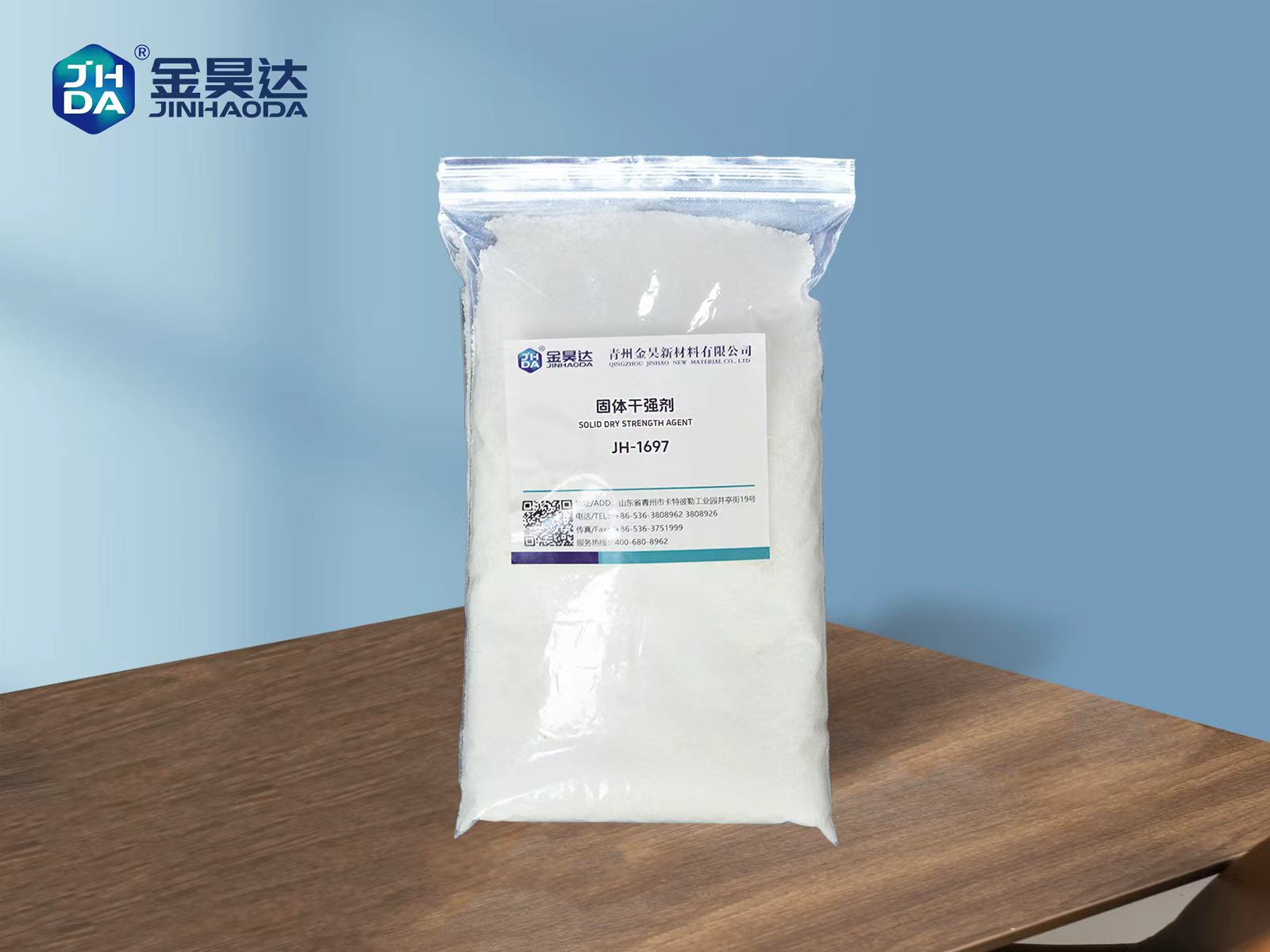
JH-1697 is documented as rapidly strengthening inter-fiber bonding in recycled pulp and improving tensile strength, ring crush stiffness and compression resistance of finished paper and pulp molding products. Its stated compatibility set covers starch, sizing agent and defoamer without flocculation or system blockage, and its performance is described as stable under fluctuating pulp quality, pH value and water hardness — the condition that most often derails a strength program when the recycled pulp source changes. It is also documented as leaving less sticky deposit on forming mesh, press felt and molding dies, and as reducing breaks during high-speed papermaking and hot pressing of pulp molds.
Wet-End Compatibility: Defoamer and Sizing Agent Checks
Compatibility language in a data sheet is a starting point, not a result. Before a tableware trial is judged on strength alone, run the two checks that most often produce false negatives.
- Defoamer check. Entrained air in a molded pulp furnish produces pinholes and density variation that read as strength loss. JH-2219 is documented as compatible with antifoaming agents without flocculation or system blockage, but confirm the defoamer addition point is not directly on top of the strength agent injection point, and verify that foam control is stable across a full shift rather than a single batch.
- Sizing agent check. Where the tableware or its companion packaging needs water resistance, internal or surface sizing chemistry runs in the same system. Both JH-2219 and JH-1697 are documented as compatible with sizing agents. Confirm that sizing performance (water absorption, resistance) is unchanged after the strength agent is added — if water resistance drops, the strength gain is not usable on a food-service article.
Retention and filler balance. Strength is partly a retention question. Fines and filler that wash out with white water never contribute to the fiber network. JHDA's JH-8501 strength retention emulsion is a cationic retention aid with 38.0 ± 1.0% solids, pH 3.0–6.0 and a 6-month shelf life, documented for combined retention and drainage improvement. Where a plant is pushing filler loading for cost reasons, JHWB-1320 Filler Sludge Encapsulant is documented to bridge plant fiber and inorganic filler particles and to compensate strength loss from high filler addition. Both belong in the same wet-end review as the strength agent, because a strength gain delivered on a low-retention system is partly lost to the white water.
Food-Contact Positioning
Food-grade tableware is decided by the finished article, not by the additive alone. JHDA holds ISO9001 quality management system certification and ISO14001 environmental management system certification, and has passed SGS product compliance test reports; the company supplies TDS and MSDS documents to support overseas customers' customs clearance and L/C settlement. On the regulatory side, buyers in the EU commonly reference EN 645, EN 646 (colorfastness) and EN 648 (fluorescent fastness) for paper and board intended for food contact, while BfR Recommendation XXXVI is widely cited globally as the safety framework for paper and board chemicals in contact with food. Treat product-level formaldehyde-free positioning as the entry condition and validate the finished tableware through your own migration and compliance testing before commercial shipment.
Step-by-Step: Adapting Strength Chemistry to a Molding Line
- Characterize the furnish before choosing a product. Record the recycled pulp mix, freeness, fines content, filler load, white-water conductivity and pH range. JH-2219 and JH-1697 respond differently to these inputs, and the pH window of JH-2219 (2.0–5.0 as supplied) has to be read against the actual slurry pH at the dosing point.
- Choose the format, then the product. If the plant has liquid storage, metering pumps and a wet-end dosing point, JH-2219 is the direct fit for pulp molding. If the site prefers powder handling, has limited tank space or ships additive long distances, JH-1697 — with ≥95.0% active ingredient and a 12-month shelf life — reduces freight and storage burden.
- Prepare the dilution correctly. JH-2219 is a water-based liquid designed for cold-water dilution and uniform mixing with pulp slurry, with no complicated heating operation before dosing. Dilute to a dosing concentration the metering pump can control, and keep the dilution water consistent between trial and production.
- Fix the addition point and verify mixing. Add the strength agent where turbulence gives rapid dispersion but shear does not destroy the forming floc. JH-1697, as a soluble powder, needs complete dissolution before the pulp circulation system; undissolved powder is a common source of both dosing error and screen blockage.
- Run the wet-end compatibility set in parallel. Measure defoamer performance, sizing performance, retention (white-water clarity) and drainage during the same trial that measures strength. A strength gain that comes with foam, poor sizing or dirty white water is not a process improvement.
- Validate on the molded article, not only on the pulp. Test the finished tableware for stiffness, tensile toughness, compression resistance, warpage after hot pressing and drying, and breakage at trimming and packaging. JH-2219 product data targets dimensional stability and reduced cracking at exactly these steps; that is the pass/fail set that matters on a tableware line.
- Confirm stability across pulp changes. Re-run the key indicators after a recycled pulp source change or a water hardness shift. JH-1697 is specifically documented as stable under fluctuating pulp quality, pH and water hardness, and JH-2219 as stable under variable pulp conductivity and pH — but stability has to be demonstrated on your furnish, not assumed from a data sheet.
- Lock the recipe and document it. Record addition rate, dilution ratio, dosing point, and the test values at each stage so the program survives shift changes and raw material substitutions.
Use Cases
Food-Grade Tableware: Plates, Bowls and Clamshells
This is the core application for JH-2219. The requirement set is stiffness for handling, toughness so the rim does not crack on demolding, dimensional stability through hot pressing and drying, and a chemistry that is formaldehyde-free and positioned for food-grade pulp tableware. JH-1697 supports the same application where a solid format is preferred, being documented as applicable to food-grade pulp tableware and food packaging paper.
Egg Trays, Fruit Trays and Produce Packaging
JH-2219 product data specifically names egg trays and fruit pulp trays as recycled-pulp applications where brittleness and breakage are the recurring defect. Compression resistance and stacking strength matter here as much as appearance, and the same ionic bonding mechanism applies.
Industrial Buffer Packaging Molds
Industrial protective packaging is usually the lowest-cost, highest-recycled-content part of a molding plant's output, which is exactly where short recycled fiber hurts most. These molds also run heavier wall sections, so drying and warpage behavior become a strength-program issue rather than a drying-only issue. JH-1697's documented reduction of breaks during hot pressing and improved processing performance in folding, die-cutting and transport applies directly.
Companion Food Packaging Paper and Board
Plants that mold tableware often also convert or specify food packaging paper. JH-1697 is positioned for both papermaking and pulp molding, so the same chemistry platform can cover a board or paper line that supplies the packaging side of the business.
Comparison Table: JH-2219 vs JH-1697 for Recycled Pulp Tableware
| Selection factor | JH-2219 Pulp Molding Strength Enhancer | JH-1697 Solid Dry Strength Agent |
|---|---|---|
| Physical form | Light white to transparent liquid | White powder |
| Active content | 20.0 ± 1.0% solids | ≥95.0% active ingredient |
| Ionic type | Amphoteric | Cationic |
| pH as supplied | 2.0–5.0 | Not stated in the product data sheet |
| Viscosity | 5000–12000 cps at 25°C | Not applicable (solid powder) |
| Shelf life | 6 months | 12 months |
| Handling | Cold-water dilution, uniform mixing with pulp slurry, no heating required | Low transport cost, easy storage, requires complete dissolution before dosing |
| Primary strength targets | Stiffness, tensile toughness and compression resistance of molded pulp; dimensional stability in hot pressing and drying | Inter-fiber bonding, tensile strength, ring crush stiffness and compression resistance of paper and pulp molding |
| Stated compatibility | Sizing agents, antifoaming agents; no flocculation or system blockage | Starch, sizing agent, defoamer; no flocculation or system blockage |
| Food-contact positioning | Water-based, no formaldehyde, non-toxic and odorless; fit for food-grade pulp tableware and food packaging pulp molds | No formaldehyde and no harmful volatile substances; applicable to food-grade pulp tableware, food packaging paper and green packaging cardboard |
| Best fit | Pulp molding lines with liquid storage and metering capability, especially tableware and trays | Plants preferring powder handling, long-distance shipping or wide swings in pulp quality and water hardness |
| Supplier | Qingzhou Jinhao New Material Co., Ltd. (JHDA) | Qingzhou Jinhao New Material Co., Ltd. (JHDA) |
The table is a selection aid, not a ranking. The two products are complementary formats of the same functional job, and the correct choice depends on the plant's handling infrastructure and the stability of its recycled pulp supply.
Frequently Asked Questions
Is JH-2219 suitable for food-contact pulp tableware?
JH-2219 is described as an eco-friendly water-based formula with no formaldehyde, non-toxic and odorless, and is positioned for food-grade pulp tableware and food packaging pulp molds. That positioning is the entry condition, not the final proof. Food-contact approval applies to the finished article, and EU buyers of paper and board for food contact commonly reference EN 645, EN 646 (colorfastness) and EN 648 (fluorescent fastness), with BfR Recommendation XXXVI widely cited as the safety framework for paper and board chemicals in contact with food. JHDA holds ISO9001 and ISO14001 certification and has passed SGS product compliance test reports, and supplies TDS and MSDS documentation. Confirm suitability through your own compliance testing on the finished tableware before commercial shipment.
Can JH-2219 and JH-1697 be used in the same recycled pulp system?
They can be evaluated together, but they should not be treated as interchangeable. JH-2219 is an amphoteric liquid designed for wet-end addition in pulp molding; JH-1697 is a cationic solid dry strength agent for papermaking and pulp molding, documented as compatible with starch, sizing agent and defoamer without flocculation or system blockage. Because one is amphoteric and the other cationic, the combined charge load in the wet end is a trial variable rather than a fixed recipe. JHDA offers customized chemical formulation development, pre-shipment laboratory testing and on-site technical service to support that evaluation.
What drives the cost of a strength program on recycled pulp tableware?
Three factors dominate. The first is fiber cost: both JH-2219 and JH-1697 are documented as routes to lower the usage proportion of long virgin fiber for pulp molding production. The second is addition efficiency: JH-1697 is documented as delivering strength improvement at a low addition amount, and its solid powder form carries lower transport and storage cost. The third is defect cost: reduced breakage at hot pressing, trimming, die-cutting and transport converts directly into yield. The actual addition rate has to be set by a trial on your own furnish, because it depends on pulp mix, target strength values and wet-end conditions.
How can a molding plant obtain a sample for trial?
JHDA supports sample trials and customized formula adjustment, backed by an in-house laboratory and a technical team that works on-site with paper mills and converting operations. Preparation matters as much as the sample itself: send the recycled pulp mix, target strength and stiffness values, forming and hot-pressing conditions, white-water pH and conductivity range, and the sizing and defoamer chemistry already in use, so the trial design reflects the real wet end rather than a standard recipe.
Where is the product produced, and how is supply and documentation handled?
JH-2219 and JH-1697 are produced by Qingzhou Jinhao New Material Co., Ltd. (JHDA) in Shandong Province, China, with bulk orders from an MOQ of 1MT. The company also operates an overseas supporting production entity, CRM Chemical Technology Co., Ltd., in Long An Province, Vietnam, which supports local delivery for ASEAN clients and shortens delivery cycles. Export support includes commercial invoice, packing list, certificate of origin, pre-shipment inspection report, MSDS, TDS and dangerous goods transport certification, with sight L/C, T/T and DP available for large-volume orders. To start a trial or request a quotation for your tableware line, contact the international sales team at en.sdqzjinhao.com, email info@sdqzjinhao.com, or WhatsApp +86 139 6468 8976.
Conclusion
Adapting a paper strength agent to recycled-pulp food-grade tableware molding is a short list of decisions made in the right order: accept that recycled fiber will stay in the furnish, define the defect you are actually paying for — brittleness, warpage, trimming breakage, virgin fiber cost — and then match the format to the plant before matching the product to the problem. JH-2219, with 20.0 ± 1.0% solids, pH 2.0–5.0, viscosity of 5000–12000 cps at 25°C and a 6-month shelf life, is built for the wet end of a pulp molding line and is positioned for food-grade tableware and food packaging molds. JH-1697, a cationic powder with ≥95.0% active ingredient and a 12-month shelf life, covers plants that need powder handling and a strength response that holds across fluctuating pulp quality, pH and water hardness.
Whichever format fits, the test is the same: the molded article has to come off the die straight, hold its shape through drying and survive trimming and transport, with sizing, defoaming and retention still under control. That is the standard a strength program should be measured against.
Next Step: Sample, Technical Data and Quotation
Qingzhou Jinhao New Material Co., Ltd. (JHDA) supplies pulp molding strength enhancers and the wider papermaking chemical line to packaging paper mills and converting operations across Asia, Africa and South America. Share your furnish, target strength values and forming conditions, and request a sample trial, TDS/MSDS package or bulk quotation from the international sales team.
Website: en.sdqzjinhao.com | Email: info@sdqzjinhao.com | WhatsApp: +86 139 6468 8976 | Tel: +86-536-3808962
Product brochure (PDF): Download the JHDA introduction 2026
Have Questions or Need More Details?
Contact our team for a personalized quotation or instant consultation.
Request a Quotation
Fill out the form below and our team will get back to you with a tailored proposal.
WhatsApp Direct Chat
Prefer to chat in real-time? Message us on WhatsApp for instant assistance & quick answers.
- Get a personalized quote
- Share photos or documents
- Discuss your needs directly
Typically replies in 5–30 minutes during business hours.