
Regulatory and Specification Checklist for Buying AKD Sizing Emulsions
Short answer: before you place a bulk order for an AKD sizing emulsion, verify four things in writing - process compatibility with your wet-end pH, the delivered solid content you are actually paying for, the batch and pre-shipment evidence behind the spec sheet, and the compliance documentation for your destination market. Everything else on the data sheet is secondary.
An AKD sizing emulsion is a formulated dispersion, not a single-ingredient commodity. Two suppliers can publish spec sheets that look almost identical and still deliver products that behave differently on the same machine, because solids, pH window, emulsifier system and batch control move together. The practical consequence is that a spec sheet should be read as a screening document and a compliance file - not as a price tag. This checklist sets out exactly what to verify, using JH-103 from Qingzhou Jinhao New Material Co., Ltd. (branded JHDA) as a worked example.
The four verification blocks: (1) chemistry fit - does the emulsion match your wet-end pH and sizing route; (2) delivered solids - what you are actually buying per ton; (3) batch and pre-shipment evidence - who checked the product before dispatch; (4) compliance documentation, including environmental and food-contact due diligence for the market your paper ships into.
Problem definition: where AKD emulsion purchases go wrong
Most AKD sizing emulsion problems are not chemistry failures. They are verification failures - the order was placed on a price per wet ton, and the questions that decide whether the emulsion works on the machine were never formally asked or answered in writing.
- Solids quoted as a range, delivered at the bottom of it. A stated range is a screening tool, not a promise. If dosage is calculated on wet weight instead of delivered solids, the mill pays for water and then compensates with higher dosing.
- A pH window that does not overlap the wet end. AKD sizing develops on a neutral-to-alkaline route. If the emulsion's stated pH limits sit outside the mill's white water pH, both retention chemistry and sizing efficiency suffer.
- Emulsion stability through transport and storage. Heat, cold and long transit can change a dispersion before it reaches the machine, and the effect usually appears later as inconsistent water resistance in the finished sheet.
- Documentation that arrives after the order. Customs clearance, customer audits and food-contact declarations all depend on documents that cannot be produced retroactively. The compliance file has to close before shipment, not after.
- Sizing reversion in converted paper. Water resistance that fades during converting or humid storage points back to formulation or dosage choices that the spec sheet alone will not reveal.
Industry background: why AKD sourcing is now a compliance question
Compliance pressure on AKD sourcing is rising because the underlying market is large, concentrated in one product family, and increasingly regulated at the destination-market level.
The global paper sizing agent market was valued at approximately USD 3.8 billion in 2025 and is projected to reach USD 5.9 billion by 2033, according to Dataintelo. Growth forecasts differ by scope and period: Market Research Future projects a 4.14% CAGR for the sizing agent market, Mordor Intelligence 5.0%, and Dataintelo 5.8%. Buyers should treat any single growth figure as an estimate rather than a planning constant.
AKD dominates the synthetic side of that market. Synthetic sizing agents, including AKD and ASA, held a 54.5% market share in 2024 (SNS Insider), and AKD sizing accounts for approximately 48% of global synthetic sizing agent volume (Dataintelo). Liquid sizing agents held a 57.8% market share in 2024 on the strength of application ease, while solid sizing agents are expected to grow at a CAGR of 5.11% through 2032 (SNS Insider). Asia Pacific accounted for a 42.3% revenue share in 2025 (Dataintelo), consistent with where packaging capacity is being commissioned.
Two regulatory anchors now sit behind most AKD purchasing files. Food contact materials placed on the EU market must comply with Regulation (EC) No 1935/2004, and paper packaging chemicals used in the United States must meet FDA 21 CFR standards for food grade safety. Both are destination-market requirements that apply to the finished paper, so the papermaker - not the chemical supplier alone - carries the final burden of proof.
Sustainability is moving into the specification as well: bio-based sizing agents reached 38% of global consumption in 2024, according to Market Reports World. That does not automatically make a bio-based emulsion suitable for a given machine, but it does mean environmental documentation is now a routine part of the purchase file rather than an optional extra.
The specification and compliance checklist for AKD sizing emulsions
1. What a JH-103 spec sheet actually states
JH-103 is an AKD sizing emulsion in the JHDA range. Its spec sheet defines two fields that buyers should treat as the primary filter: a solid content range of 12.5-25%, and neutral-to-alkaline process compatibility. The pH limits stated on the TDS are the third field to read, because they determine whether the emulsion fits the wet end - rather than the wet end having to be adjusted to fit the emulsion.
Qingzhou Jinhao New Material Co., Ltd. was founded in 2005 and operates from Mihe Industrial Park, Qingzhou City, Shandong Province, China, producing papermaking fine chemicals across sizing, strengthening, retention, defoaming, biocides and functional coatings. Its sizing series covers AKD neutral sizing emulsion, anionic styrene-acrylic surface sizing agents and rosin sizing. That breadth matters for verification: an internal AKD emulsion and a surface sizing agent solve different problems, so a spec sheet comparison is only meaningful within the same product family.
2. Process compatibility: neutral to alkaline
AKD sizing is designed for neutral-to-alkaline papermaking systems, where the sizing reaction proceeds without the acid conditions that rosin-alum sizing depends on. For a mill running a neutral or alkaline wet end, JH-103's stated compatibility removes the first barrier to adoption. For a mill still operating an acid rosin route, the correct answer is not to force an AKD emulsion into the system - it is to select a sizing chemistry that matches the process, which is why the JHDA portfolio also includes rosin sizing.
The practical verification step is a pH comparison. Take the pH limits printed on the JH-103 TDS and compare them with the white water pH range your mill records daily. If the emulsion's stated limits sit comfortably inside that window, the chemistry is a candidate. If they only touch the edge of the window, expect dosage to drift upward after startup.
3. Solid content: what you are actually paying for
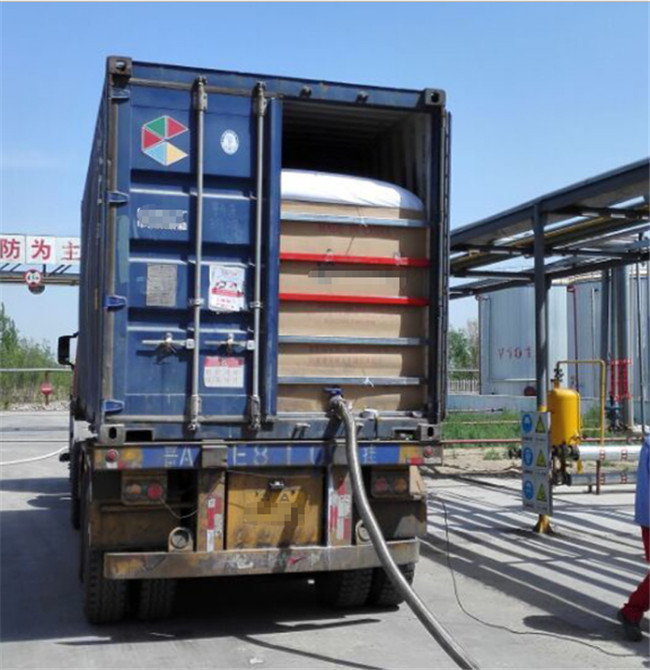
A solid content range of 12.5-25% means the delivered emulsion can contain roughly twelve to twenty-five parts of active material per hundred parts of wet product, depending on the grade selected. The range exists for a reason: mills running high-dose internal sizing and mills running low-dose surface applications do not need the same concentration. The commercial consequence is straightforward. Cost comparisons must be made per unit of delivered solids, and dosage calculations must be anchored to the solids figure on the batch certificate - not to the wet weight of the drum, IBC or flexibag.
4. Batch, laboratory and pre-shipment evidence
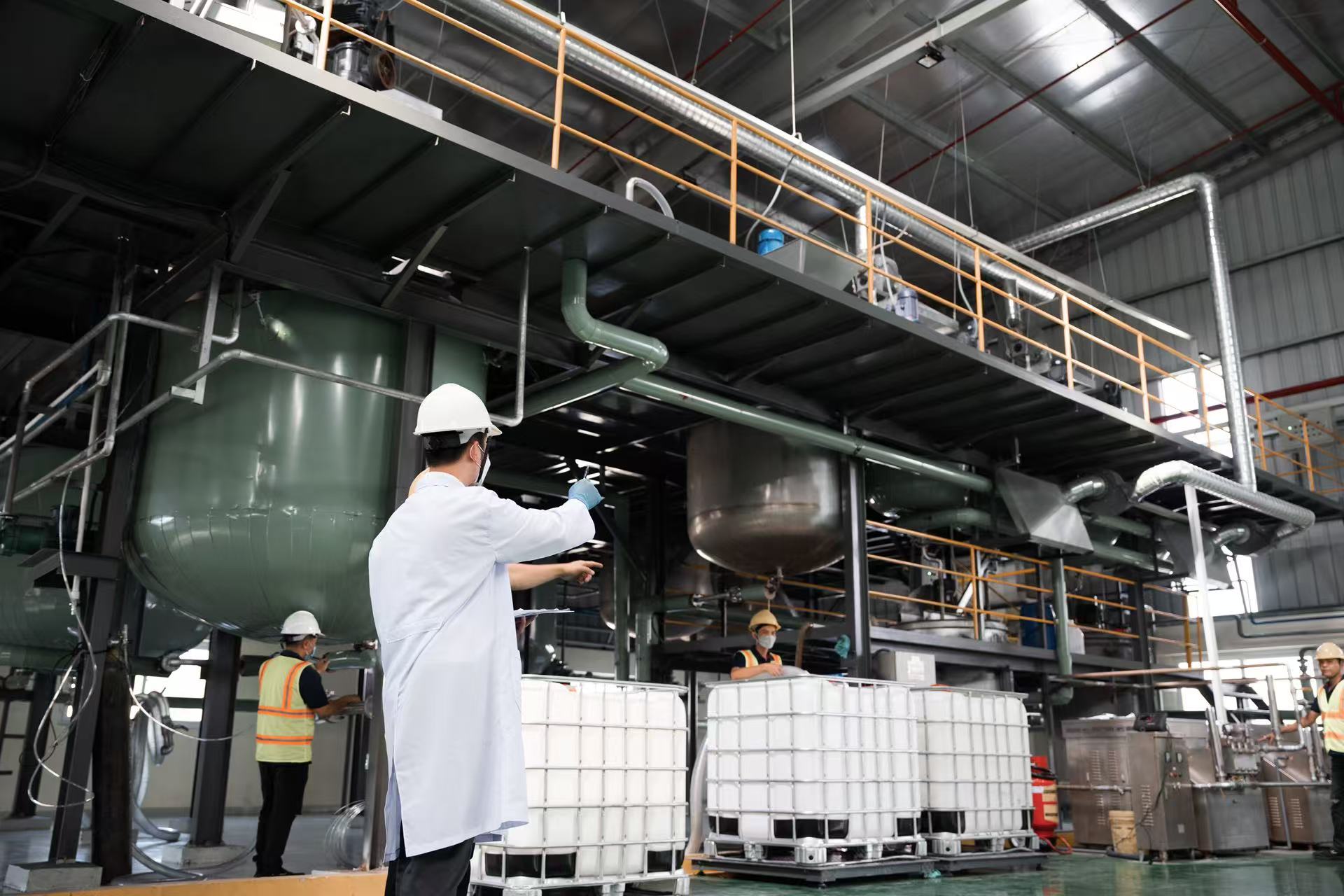
A specification is only as reliable as the production system behind it. Qingzhou Jinhao operates standardised automated production lines for both liquid and solid papermaking chemicals, which is what makes consistent batch quality feasible at an MOQ of 1MT and above. The company provides pre-shipment laboratory testing, and its field technical team performs on-site machine commissioning at paper mills, optimising core indicators including Cobb water absorption value, ring crush strength, bursting strength, paper brightness, fibre retention rate and overall paper machine runnability.
For buyers, that translates into three documents to request by name: the TDS and MSDS for the specific emulsion grade, the batch test report, and the pre-shipment inspection report. If a supplier cannot produce the third, the first two remain unverified claims.
5. Compliance documentation for the destination market
Compliance in this category has two layers: what the manufacturer holds, and what the buyer's market requires. Both belong in the same purchase file.
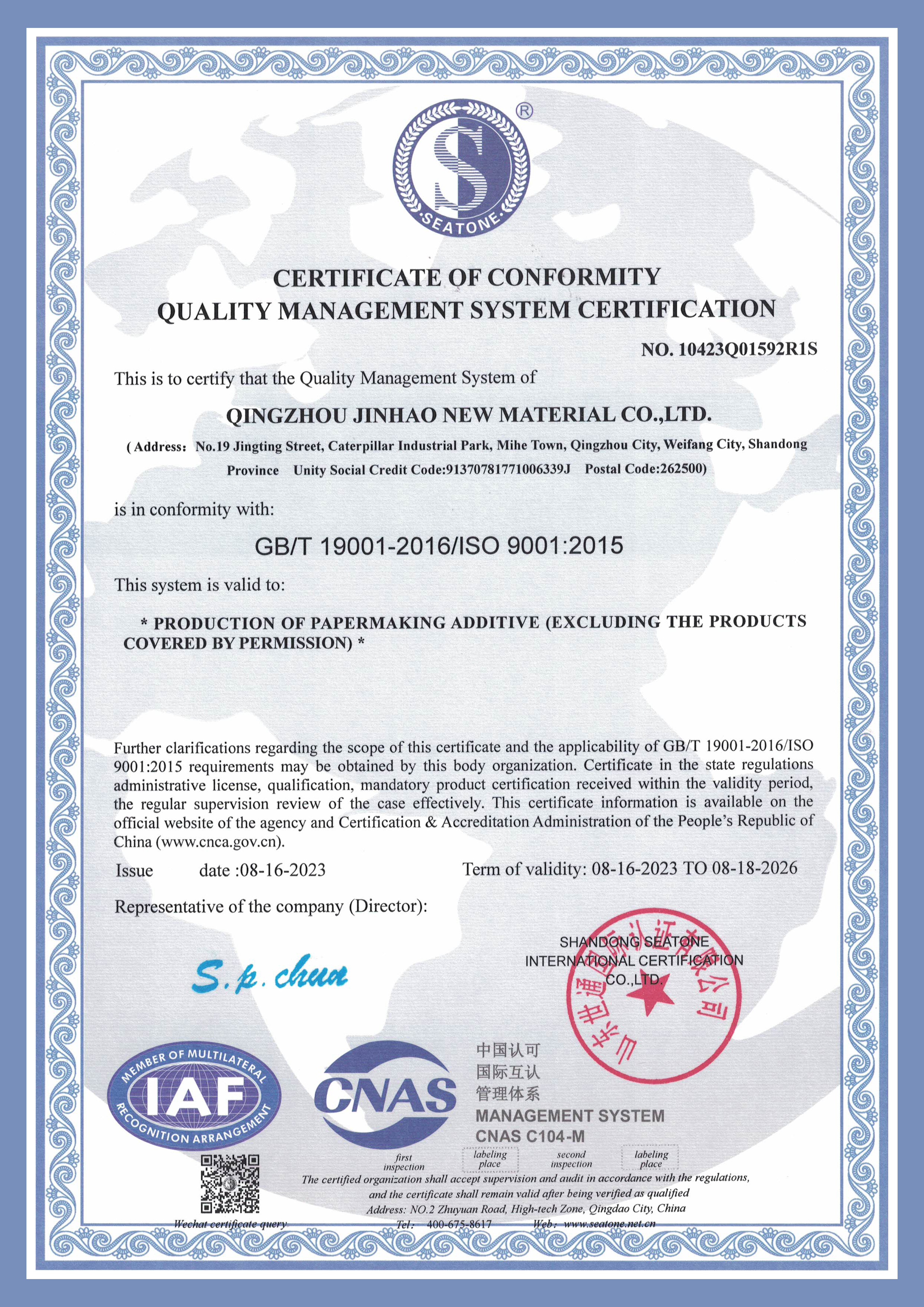
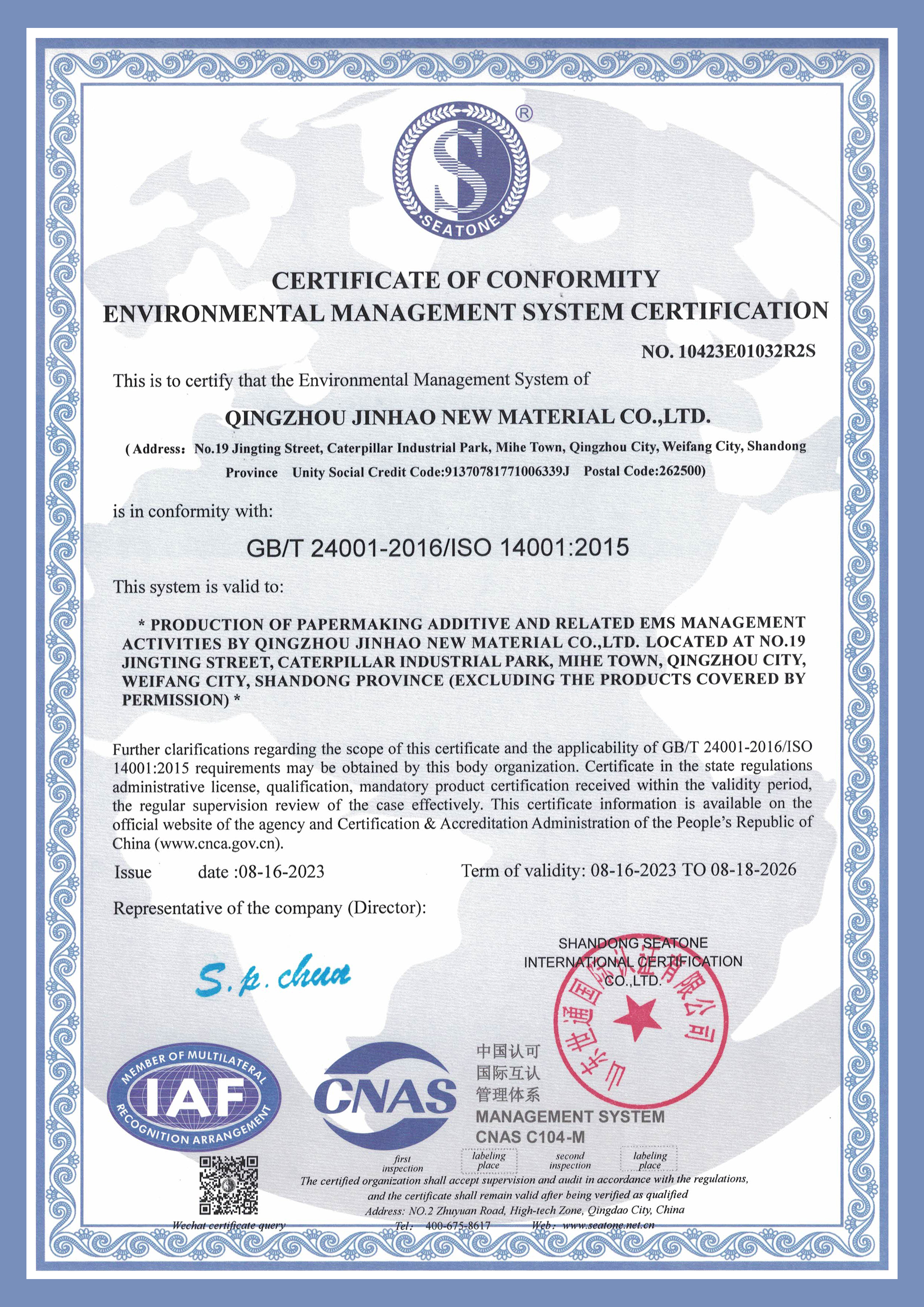
At the manufacturer level, Qingzhou Jinhao holds ISO9001 quality management system certification and ISO14001 environmental management system certification, and has passed SGS product compliance test reports and SGS food contact safety testing for packaging paper chemicals. For export orders, the company's products complete CAS registration and GHS hazard labelling, and shipments comply with IMDG international marine shipping regulations. JHDA supplies one-stop export documentation including commercial invoice, packing list, certificate of origin, pre-shipment inspection report, MSDS, TDS and dangerous goods transport certification - the document set that overseas customers need for customs clearance and L/C settlement.
At the buyer level, due diligence means mapping the emulsion to the rules that govern the finished paper. Papermakers supplying food-contact board into the EU should be able to show that materials comply with Regulation (EC) No 1935/2004; those supplying the US market should be able to show compliance with FDA 21 CFR. Environmental compliance is jurisdiction-specific: no supplier certificate replaces a check against the permits and reporting obligations that apply at your own site. Practical steps are to request the certificate itself rather than a description of it, confirm scope and validity dates, and file the SGS food contact safety test report alongside the MSDS. Where a supplier operates more than one production site - JHDA, for example, also runs a supporting production entity, CRM Chemical Technology Co., Ltd., in Long An Province, Vietnam - confirm which site will serve your order and that the environmental management system covers it.
6. How the documentation package holds together
JHDA issues TDS and MSDS for each grade to support overseas clearance and letter-of-credit settlement, and complements them with CAS registration, GHS labelling and IMDG-compliant transport documentation. The company also supports factory audit visits for global chemical distributors and terminal paper manufacturers - a practical route to verifying production capability, laboratory practice and environmental controls before a supply agreement is signed. For a buyer in the decision stage, an audit visit replaces a large amount of unverifiable supplier claims.
Step-by-step: verifying an AKD sizing emulsion before you commit
- Request the TDS and MSDS before price discussions. The data sheet tells you whether the product is even in scope. A price without a specification cannot be compared with another offer.
- Fix your dosage basis on delivered solids. Read the solid content range, confirm the grade you intend to order, and calculate cost and dosage per unit of active material.
- Match the pH limits to your white water. Overlap between the TDS pH limits and the mill's daily white water pH range is the single fastest screening test available.
- Confirm process compatibility in writing. Ask whether the grade is intended for neutral-to-alkaline or acid systems, and require the answer on the TDS rather than in an email thread.
- Request batch data and the pre-shipment inspection report. These establish whether the specification is reproduced in production, not just in the laboratory.
- Build the compliance file before ordering. Collect certificates, CAS registration, GHS labelling, MSDS/TDS, dangerous goods transport certification, and - where relevant - SGS food contact safety testing. Then map that file to the requirements of your destination market.
- Run a trial with pre-agreed acceptance criteria. Define which indicators the trial must move - typically Cobb water absorption value, ring crush strength and bursting strength - and have the supplier's technical team on site for machine commissioning.
- Confirm commercial and logistics terms. MOQ is 1MT; delivery terms are FOB or CIF; payment terms include T/T and L/C. Pre-shipment testing is the acceptance criterion that ties the whole process together.
Use cases: where this checklist changes the outcome
Carton board and corrugated containerboard
Containerboard mills running recycled pulp are the most price-sensitive AKD buyers and the most exposed to sizing inconsistency, because dosage is tuned continuously against board grade changes. For these mills the solids figure on the batch certificate is not paperwork - it is the number that determines how much emulsion goes into the wet end that day. AKD neutral sizing emulsion is part of the JHDA sizing series, and the company also supplies an anti-humidity sizing auxiliary aimed at corrugated carton damp collapse issues.
Food packaging board
When the finished board contacts food, the document trail becomes the product requirement. Buyers in this segment should hold SGS food contact safety testing for packaging paper chemicals, the MSDS and TDS for the exact grade, and a clear mapping to the destination market's framework - Regulation (EC) No 1935/2004 in the EU, FDA 21 CFR in the United States. JHDA's product portfolio includes food-grade water vapour barrier coating and hydrophobic coating for food packaging paper, so grade selection must be confirmed in writing rather than assumed from the product family.
Printing and writing paper
Cultural paper mills care about ink penetration and surface uniformity, not only water resistance. Verifying solid content and pH compatibility matters here because unstable sizing shows up as print mottle rather than as an obvious sizing failure - and by then the batch has already been consumed.
Mills in humid or rainy-season conditions
Where ambient humidity is high for part of the year, moisture regain in finished paper and board is a recurring complaint. AKD sizing performance and anti-humidity auxiliaries are typically reviewed together in these mills, which makes the trial stage more important and the acceptance criteria broader than a single Cobb measurement.
Distributors and importers building a long-term supply line
Chemical distributors rarely have machine-side technical staff, so the supplier's documentation and support model becomes their product. Factory audit visits, TDS/MSDS coverage for every grade, pre-shipment testing and a defined export document set are the assets that make an AKD emulsion resellable - not the headline price.
Comparison table: what to verify, field by field
| Spec sheet / document field | What to verify | Why it decides fit |
|---|---|---|
| Solid content | JH-103 states a range of 12.5-25%; check the batch certificate against the grade ordered | Dosage, freight cost and cost per active unit all follow delivered solids |
| Process compatibility | JH-103 is designed for neutral-to-alkaline systems | AKD chemistry does not suit an acid rosin-alum route; a rosin grade is the correct fit there |
| pH limits | Compare TDS pH limits with the mill's daily white water pH range | A mismatch appears as higher dosage and unstable sizing |
| Form | Liquid emulsion | Liquid sizing agents held a 57.8% market share in 2024 on ease of application (SNS Insider) |
| Pre-shipment testing | Confirm testing is performed before dispatch | The inspection report is the only independent check available to a remote buyer |
| Commercial terms | MOQ 1MT; delivery FOB or CIF; payment T/T or L/C | Determines trial scale, cash flow and how quickly the first evaluation can start |
Comparison table: export and compliance documents to hold
| Document | What it establishes | Where buyers typically get stuck |
|---|---|---|
| TDS and MSDS | Grade specification and safe handling | Generic documents that do not match the grade actually shipped |
| Batch test report and pre-shipment inspection report | That the specification is reproduced in production | Requested after the order instead of before |
| Commercial invoice, packing list, certificate of origin | Customs clearance and letter-of-credit settlement | Inconsistencies between paperwork and shipped quantity |
| CAS registration and GHS hazard labelling | Chemical identity and hazard communication | Labels not aligned with the local language or format requirement |
| Dangerous goods transport certification (IMDG) | Marine shipping compliance | Missing at booking stage, delaying the container |
| ISO9001 and ISO14001 certificates | Quality and environmental management systems | Scope or validity date not checked against the supplying site |
| SGS product compliance test report and SGS food contact safety testing | Third-party verification relevant to packaging paper chemicals | Assuming it covers the destination market without checking |
FAQ
What certifications and reports should I verify before buying an AKD sizing emulsion?
Ask for the quality and environmental management certificates plus the third-party test reports that back the specification. Qingzhou Jinhao New Material Co., Ltd. holds ISO9001 quality management system certification and ISO14001 environmental management system certification, and has passed SGS product compliance test reports and SGS food contact safety testing for packaging paper chemicals. For export shipments, JHDA completes CAS registration and GHS hazard labelling and complies with IMDG international marine shipping regulations. Verify the certificate scope and validity dates, and confirm they cover the production site that will serve your order.
Is JH-103 compatible with neutral-to-alkaline papermaking, and what solid content should I expect?
JH-103 is an AKD sizing emulsion formulated for neutral-to-alkaline process compatibility, and its spec sheet states a solid content range of 12.5-25%. The pH limits on the TDS must overlap with your white water pH range; that overlap, not the headline price, is what determines whether dosage stays stable after startup. Because the solid content is given as a range, calculate dosage and cost per unit of delivered solids and confirm the figure on the batch certificate for the grade you order.
How should I compare pricing between AKD sizing emulsion suppliers?
Compare cost per unit of delivered solids rather than cost per wet ton, then add freight, customs and the dosage your machine actually needs. JHDA documents that its integrated process chemical approach cuts the comprehensive wet-end chemical cost per ton of finished paper by 10-20% while reaching the same paper quality standard supported by Kemira, BASF and other international premium brands - a first-party claim that buyers should validate with a trial on their own machine. Suppliers that cannot state solid content, process compatibility and pH limits in writing are not comparable offers.
Can I test an AKD sizing emulsion before committing to a bulk order?
Yes. Sample and trial arrangements sit inside the standard commercial framework: MOQ is 1MT, delivery terms are FOB or CIF, payment terms include T/T and L/C, and the acceptance criterion is pre-shipment testing. JHDA provides pre-shipment laboratory testing and supports on-machine commissioning by its field technical team, who optimise indicators such as Cobb water absorption value, ring crush strength, bursting strength and fibre retention rate during the trial.
What should I look for in a long-term AKD sizing emulsion supplier for carton board?
Look at supply continuity, local support and documentation discipline rather than at a single quotation. JHDA has maintained stable strategic cooperation with dozens of large-scale packaging paper mills in Southeast Asia for more than 10 years, supports factory audit visits for global chemical distributors and terminal paper manufacturers, and operates a supporting production entity, CRM Chemical Technology Co., Ltd., in Long An Province, Vietnam, to shorten delivery cycles for ASEAN clients. For carton board exposed to humid conditions, JHDA also supplies an anti-humidity sizing auxiliary aimed at corrugated carton damp collapse. To move from evaluation to execution, request a sample trial or a bulk quotation with TDS and MSDS attached - the full product introduction is available in the downloadable brochure below.
Conclusion
Buying an AKD sizing emulsion is a documentation exercise as much as a chemistry decision. A spec sheet that states a solid content range and a process compatibility window, such as JH-103's 12.5-25% solids and neutral-to-alkaline design, gives you a screening filter - but the purchase only becomes defensible when the pH limits match your white water, the batch certificate matches the ordered grade, and the compliance file closes before the container sails.
Work through the four blocks in order: chemistry fit, delivered solids, batch and pre-shipment evidence, and destination-market compliance. Then run a trial with pre-agreed acceptance criteria and confirm the commercial terms. That sequence costs a few weeks and removes the most common causes of sizing rework, off-spec board and delayed clearance.
Next step: verify, then trial
Request the JH-103 TDS, MSDS and pre-shipment test protocol, or ask for a sample trial and bulk quotation. MOQ 1MT, FOB/CIF delivery, T/T or L/C payment.
Qingzhou Jinhao New Material Co., Ltd. (JHDA) - founded 2005, Mihe Industrial Park, Qingzhou City, Shandong Province, China.
Website: en.sdqzjinhao.com
Email: info@sdqzjinhao.com | Tel / WhatsApp: +86 139 6468 8976 | Tel: +86-536-3808962
Download the product brochure: JHDA Papermaking Chemicals Introduction (PDF)
Have Questions or Need More Details?
Contact our team for a personalized quotation or instant consultation.
Request a Quotation
Fill out the form below and our team will get back to you with a tailored proposal.
WhatsApp Direct Chat
Prefer to chat in real-time? Message us on WhatsApp for instant assistance & quick answers.
- Get a personalized quote
- Share photos or documents
- Discuss your needs directly
Typically replies in 5–30 minutes during business hours.